The Cost of Not Knowing
Close the information gaps behind your next important business decision.
Organizations rarely suffer from a shortage of information. They suffer from uncertainty about which information can be trusted.
Leaders make decisions using performance measures, customer feedback, employee comments, online reviews, sales data, surveys, conversations and years of experience.
But what happens when those sources don’t answer the question that really matters? Or worse—when the information appears convincing but is wrong?
A Conversation About Decisions
The Cost of Not Knowing is a 60–75 minute executive presentation designed for leadership teams, professional associations and other groups whose decisions depend on understanding customers, employees, members or other stakeholders.
This is not a condensed course in survey methodology.
It is a conversation about what happens when important decisions are made while important information is missing—or when unreliable information is mistaken for reliable evidence.
Participants examine how information gaps develop, why assumptions and anecdotes can become accepted as facts, and how survey research can help when the right information is unavailable.
The Questions Leaders Should Be Asking
- What do we actually know?
- What are we assuming?
- What evidence supports those assumptions?
- Whose perspective might be missing?
- What would we like to know that we don’t know now?
- Would knowing it change our decision?
- And if we collect new information, can we trust the answer?
What Participants Will Explore
- How to distinguish symptoms from underlying questions
- How information gaps develop inside organizations
- Why leadership perceptions and stakeholder experiences can differ
- When surveys can help reduce uncertainty—and when they cannot
- How poorly designed surveys can create false confidence
- Why large numbers of responses do not automatically produce reliable evidence
- How better information can support better decisions
From Awareness to Capability
For some organizations, the presentation is enough to change how leaders think about information and evidence. For others, it raises another question:
Do we have people inside our organization who know how to investigate an important information gap properly when one arises?
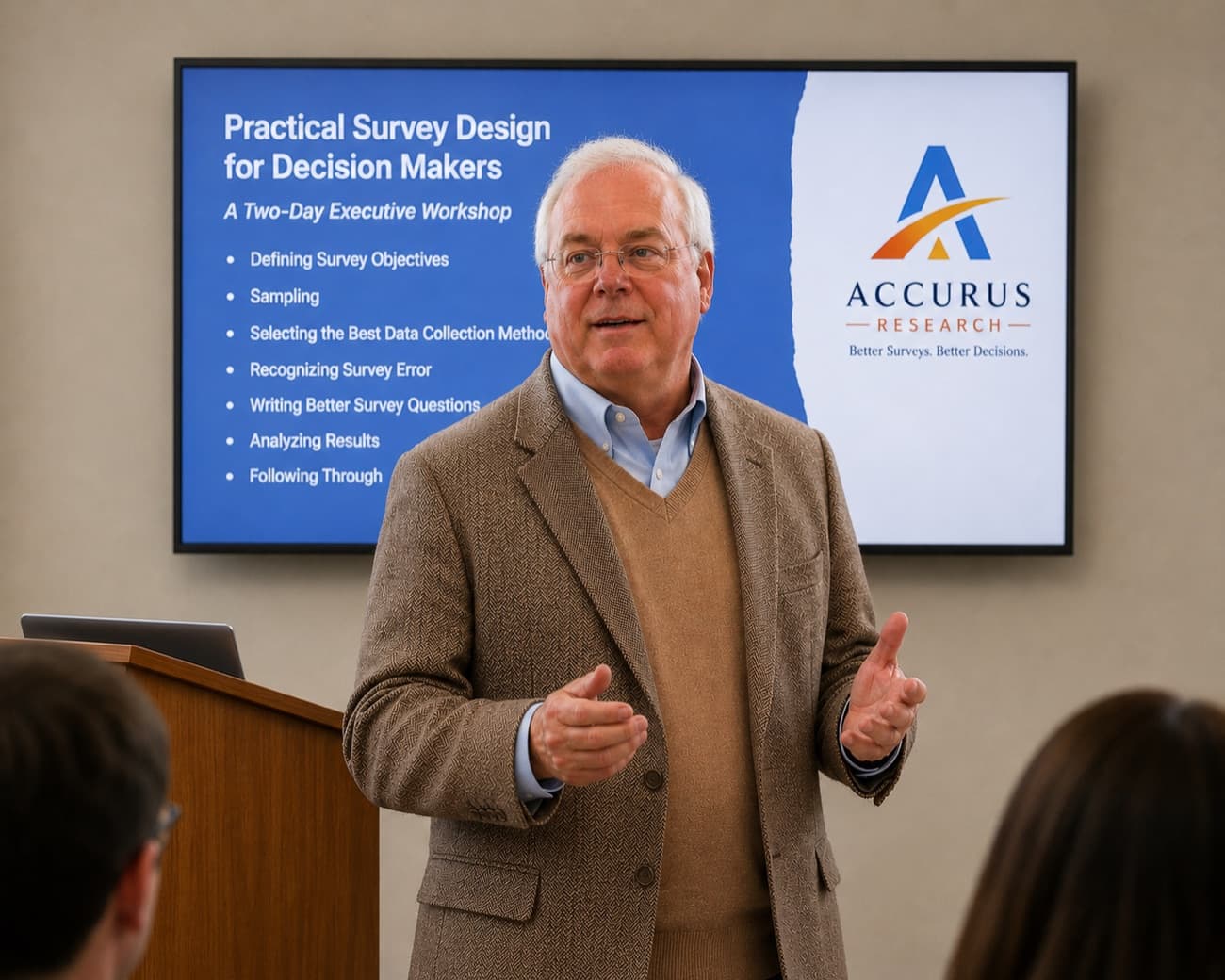
The Accurus Research two-day workshop is designed to build that capability.
Bring The Cost of Not Knowing to Your Leadership Team or Organization
Whether you’re considering an executive presentation, the two-day workshop, or a second set of eyes on an upcoming survey, a conversation is the right place to start.